
By Catalina Clarke
Every Group Moved. Catalina Clarke is Editor-in-Chief of The Library Media.
Start with what the chart gets right, because it is the story: in the 2026 midterms, every major demographic group in America moved toward the Democrats. Not most groups. Every group the national exit polls break out — white men, white women, Black men, Black women, Latino men, Latino women — each one shifted, and the Republican share of the vote fell in all of them compared with 2024. Waves are usually described as tides lifting one coalition. This one moved the whole shoreline.
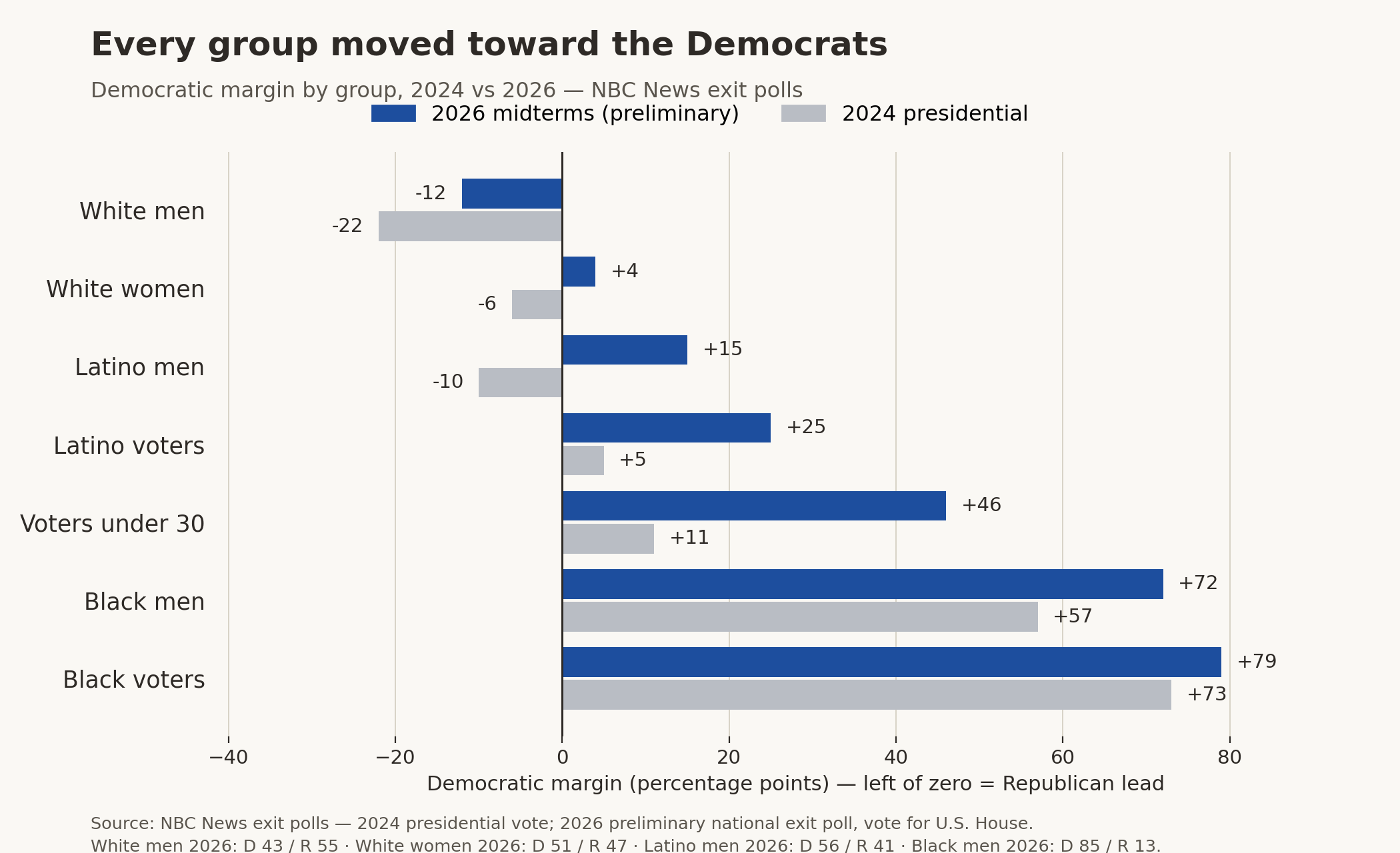
The decisive bloc was the largest one: white women, thirty-six percent of the electorate. In 2024 they voted Republican, 53 to 47. In the preliminary NBC News exit poll for 2026, they voted Democratic, 51 to 47 — an outright flip of the biggest single group in American politics. And it was not an abstraction: state exit polls show white women delivering the supposedly impossible races. They backed Amy Acton in Ohio at 52 percent, Adam Hamilton against Senator Roger Marshall in Kansas at 53, Roy Cooper in North Carolina at 55, and Josh Turek in Iowa at 55. The Senate map did not flip in the abstract. It flipped in those columns.
The largest swing belonged to Latino men. In NBC’s 2024 exit poll they favored Republicans 54 to 44 — the centerpiece of the Trump coalition’s celebrated expansion. In 2026 they favored Democrats 56 to 41: a twenty-five-point reversal of margin in two years. Latino voters overall moved from a five-point Democratic edge to a twenty-five-point one, giving Democratic House candidates roughly sixty-two percent of their vote. Whatever was purchased in 2024 with those voters was not renewed.
Black men tell the same story in a quieter register. Roughly one in five voted for Trump in 2024 — a figure that launched a thousand essays about a realignment. In 2026, NBC’s exit poll puts the Republican share of Black men’s House vote at thirteen percent; the AP Voter Poll puts it nearer one in ten. Black women remained the coalition’s foundation at roughly nine in ten Democratic. The 2024 inroads were not consolidated. They were rented, and the lease expired.
And then there are the young. Voters under thirty went from an eleven-point Democratic margin in 2024 to a forty-six-point margin in the preliminary NBC figures — with young men, the demographic the last two years of politics were supposedly reorganizing, voting Democratic 68 to 28. Men overall, a twelve-point Republican advantage in 2024, finished at a single point. The only group in the NBC table that moved toward Republicans at all was voters sixty-five and older — and even there, by three points of margin.
Two cautions belong on the record, because this desk prints them. Exit polls are preliminary; they are reweighted as the count completes, and the final figures will move at the edges. And 2024 was a presidential electorate voting for president, while 2026 was a midterm electorate voting for the House — the comparison measures direction, not destiny. But direction is the news here. $446 million was spent, in part, to hold a coalition together. The maps were redrawn, in part, to protect it. On Tuesday, every single group in it moved the other way — and the group that moved first and farthest was the one that makes up more than a third of the country.
From The Library — the estate of our family.